Out and about in nature.

Farm animals and wildlife in the Lower Engadine
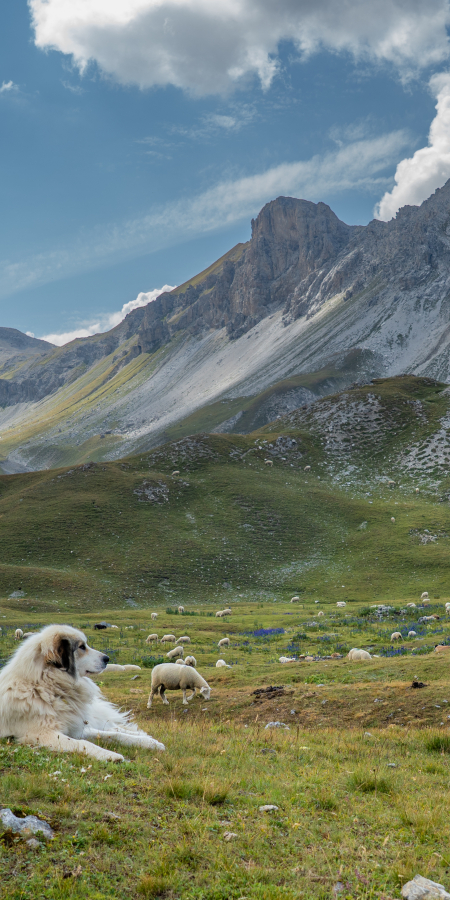
Herdeschutzhund
While hiking, you are in the habitat of various farm and wild animals. In addition to herds of mother cows and guard dogs, bears and wolves currently live in the Lower Engadine.
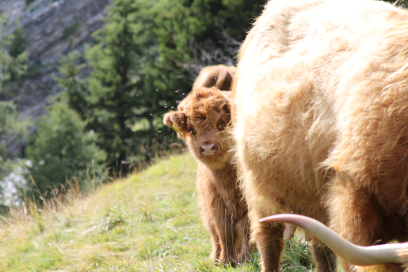
Mutterkuh mit Kalb

Suckler cows and herd protection dogs in the Lower Engadine

This map shows the current locations of suckler cows and livestock guard dogs in our region. Please note that not all herds are included and that locations may vary by a few days depending on the weather and vegetation.

Suckler cows and herd protection dogs

In the Lower Engadine, suckler cows graze with their calves in summer. Livestock guard dogs also watch over flocks of sheep. To ensure that both people and animals can enjoy the countryside in peace, the locations have been digitally mapped and clearly marked. The map makes it easier to plan outings and helps to avoid conflicts.

In addition, a set of guidelines explains how to behave when encountering herds and dogs.

Out and about in the habitat of predators
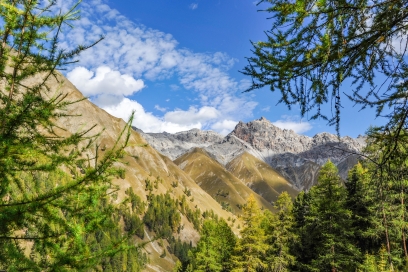
Schweizerischer Nationalpark

The most important rules of conduct

If the rules of conduct are observed, there is no danger to hikers, bikers or touring skiers due to wild animals. All outdoor activities can be carried out as before despite the wolf population in Graubünden.

  • As a matter of principle, recreational activities should take place on signed paths and places. The habitats of all wild animals must be respected.
  • Make sure that the animals are not attracted by openly accessible, potential food (e.g. by litter). Do not dispose of food leftovers in the forest (e.g. at barbecue sites), even in small quantities.

What should I do if I come across a bear?

  • Stay calm and try to assess the situation calmly.
  • Under no circumstances approach the bear, and avoid anything the bear might perceive as a threat.
  • Make it clear that you are human and move away without taking your eyes off the bear.
  • Avoid eye contact.
  • Do not leave any rubbish behind and do not attract bears with food.
  • Stay on the footpaths and keep your dog on a lead.
  • Report any sightings of bears or their tracks to the local gamekeeper.

What should I do if I come across a wolf?

  • Stand still and try to assess the situation. If the wolf notices you, it will usually back off or run away.
  • If the wolf does not run away immediately, draw its attention to yourself by speaking in a firm voice.
  • Back away slowly; the wolf will watch you or run away straight away.
  • Under no circumstances should you try to approach the wolf, not even to take photos.
  • Never chase a wolf.
  • Wolves must not be fed under any circumstances!
  • Report wolves exhibiting unusual behaviour or showing little fear to the gamekeepers.
  • Wolves may regard dogs as intruders or prey. Always keep your dog under your personal control or keep it on a lead.
Mehr anzeigen
Grossraubtierbeobachtung

Map. Current observations of large predators

The map of the Cantonal Office of Hunting and Fishing provides an overview of the distribution and occurrence of wolves and other large carnivores in the canton of Graubünden.

To the map

Field trips and events on the topic of large predators

Mehr anzeigen
Wolf
8.7. | 15.7. | 22.7. 2026 Val Müstair
Sharp teeth, big questions

Accompanied by a nature park ranger, participants hike up to the alpine pastures, learning more about the lifestyles of wolves, bears and lynx, and what their presence entails. At the alp, the herdsmen talk about their daily lives and show how tradition, conservation and nature shape their work.

Jetzt geöffnet bis ${formattedHours.closesAtString}
Geschlossen
Öffnet wieder am ${formattedHours.nextOpening.opensAtString}
${formattedHours.notice}
Mehr anzeigen
Uina Tal
16.7 | 13.8. 2026 Uina, Engadin
Uinatal: a wild valley – home to bears, lynx and wolves too?

A spectacular hike through the Uina Gorge. Along the way, you’ll learn lots of fascinating facts and stories about the return of large predators. In 2005, the first bear in almost 100 years was spotted in Switzerland in this remote valley.

Jetzt geöffnet bis ${formattedHours.closesAtString}
Geschlossen
Öffnet wieder am ${formattedHours.nextOpening.opensAtString}
${formattedHours.notice}
Crap Puter
23.7. | 20.8. 2026 Tarasp, Engadin
The Schafberg – one of the most beautiful mountains offering panoramic views, even for the wolf?

We’ll be hiking across the Laisch Alp and the Schaf Alp to the Crap Puter (2,368 m). Along the way, we’ll learn lots of fascinating facts and stories about wolves, bears and lynx, as well as about the project on tourism and large carnivores.

Jetzt geöffnet bis ${formattedHours.closesAtString}
Geschlossen
Öffnet wieder am ${formattedHours.nextOpening.opensAtString}
${formattedHours.notice}
Mehr anzeigen
Buffalora
24.7 | 7.8. | 7.10. 2026 Buffalora, Val Müstair
Special Excursion: Large Carnivores

Wolves, lynx and bears are once again part of the Alpine landscape and can also be found in the Swiss National Park. During the field trip to the Buffalora area, we will explore their way of life, behaviour and ecological significance. At the same time, we will examine different perspectives from forestry, agriculture, hunting, nature conservation and the National Park, and discuss current challenges and possible solutions regarding the management of large predators.

Jetzt geöffnet bis ${formattedHours.closesAtString}
Geschlossen
Öffnet wieder am ${formattedHours.nextOpening.opensAtString}
${formattedHours.notice}
Mehr anzeigen
Wald_Val Sinestra
28.7 | 4.8. | 9.9. 2026 Val Sinestra, Engadin
Wanderers – large predators – livestock protection

We’ll be hiking through the Val Sinestra, where a new wolf pack has formed in 2025. Learn more about the social lives and behaviour of predators. In alpine areas, you’ll come across livestock guard dogs. How should you behave in such situations? Information on livestock protection measures and changes in the natural world since the arrival of large predators will broaden your knowledge.

Jetzt geöffnet bis ${formattedHours.closesAtString}
Geschlossen
Öffnet wieder am ${formattedHours.nextOpening.opensAtString}
${formattedHours.notice}