
 Winter sports report
  Webcams
  Hiking and Bike Tours
  Events
  Vouchers
 Alpine cheese from the Prà San Flurin alp
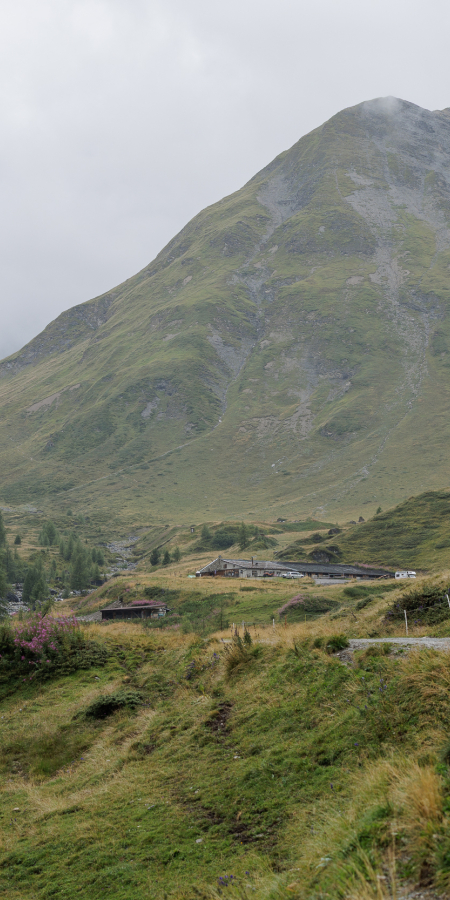
It's a way of stepping back. A return to basics. Connecting with nature and animals. You realize how little you need to be content and happy.
Christian Kofler Alpine herdsman on the Prà San Flurin mountain pasture
Work on the alp begins around 3 a.m. The team - consisting of the herdsman Christian, his daughter Ayuna, her friend Jana, and the assistant Felice - is a well-coordinated group.

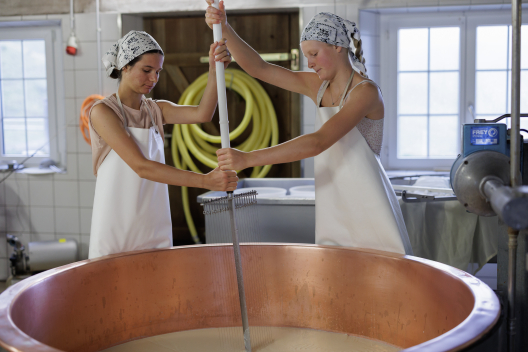
While it is still dark, Ayuna and Jana milk the cows using a milking machine. The raw milk is then heated in a copper kettle and enriched by Christian with rennet, an enzyme derived from a calf’s stomach. This causes the milk to curdle as the milk protein (casein) separates from the watery part—the whey—and combines with the milk fat to form the cheese.
Using a cheese harp, the two friends stir the curd—a thick, viscous mass—into pieces, known as curd. This mass is then lifted out of the copper kettle with a cloth and placed into round containers before being stored in the cheese cellar to mature.
Around noon, it’s finally time for a break before heading out again in the early afternoon to round up and milk the animals. The workday draws to a close between 8 and 9 p.m.
«The tiredness only sets in once you sit down,» says Ayuna.
During the alpine season, the more than 70 cows produce between 55,000 and 60,000 liters of milk. About 5 to 7 metric tons of cheese are produced. A wheel of alpine cheese has a diameter of about 28 centimeters, Christian explains.
His daughter Ayuna and her friend Jana really enjoy the secluded life on the alp. Ayuna especially likes watching the milk turn into cheese. When asked what the best moments have been, she replies with a smile:
When a farmer came up to us and praised us for making good cheese and doing a good job. That makes me happy.
Ayuna
Her friend Jana fondly remembers a hike with a picnic on a hot day in July, as well as the shooting stars they saw.
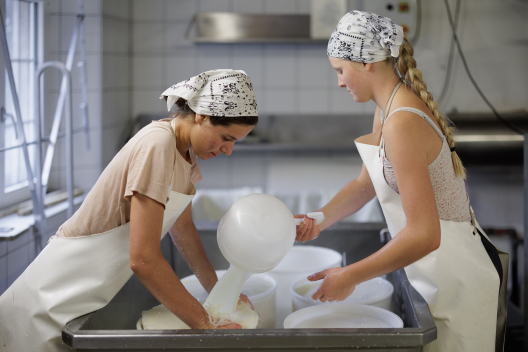
Christian, who received the silver award for his cheese at the 26th cantonal Alpine cheese competition at the Plantahof in Landquart, emphasizes the joy he finds in his work and the contentment the animals radiate. «They are quite sensitive and reflect your own mood.»

He describes the arrival of wolves as a challenge. Sheep have already been killed near the alp, and as a result, someone has been assigned to monitor the herd, even using night-vision equipment. Christian is concerned that the alp’s dogs might chase the wolves and be attacked.
Climate change is also a problem, with increasing extreme weather events such as heavy rain and longer periods of drought, as Fadri Stricker, president of the Sent Alpine Pasture and Dairy Cooperative, explains. A few years ago, there was a very mild winter. The following summer, water for electricity and water supply became very scarce.
The cooperative in Sent is made up of the village’s dairy farmers. Fadri is proud of the sense of community within the cooperative, as everyone pitches in to help with everything.
Alpine cheese and other products made from the milk of the Sent farmers’ cows can be purchased at the Lataria Sent, a retail store.

In September, the cows are led back to Sent from the Prà San Flurin alp in Val Laver. Christian, Ayuna, Jana, and Felice have dressed up in traditional clothing for the occasion. The cows are led across the village square in Sent to Fadri Stricker’s farm, where a festival stand is set up.
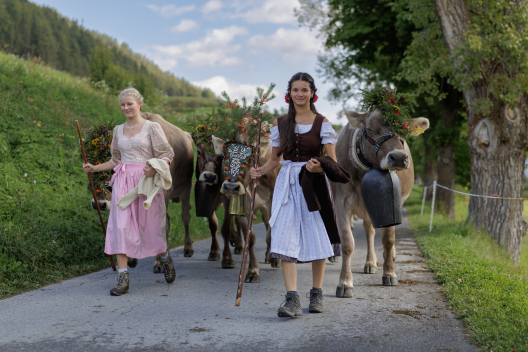
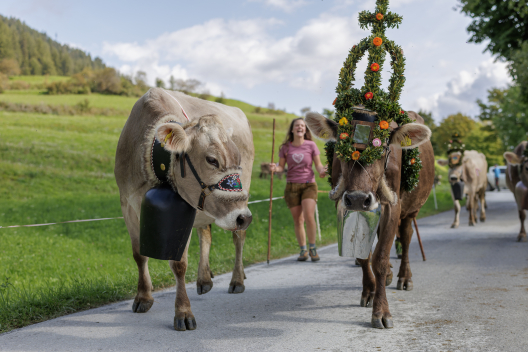
For me, the return from the alp is like a personal farewell. You've grown close to the animals.
Christian Kofler
Christian isn't sure yet what he'll do after this summer on the alp. His daughter and her friend Jana, however, would very much like to spend another summer on the alp.

Images and Text: Dominik Täuber


